Smart Cost-Cutting for Sustainable Business Growth
Managing a business often feels like navigating a complex financial funnel. You have revenue pouring in at the top, but by the time it filters through operations, salaries, and overhead, the flow at the bottom can feel disappointingly thin. To truly scale, you cannot simply focus on pouring more water into the top; you must ensure the funnel itself isn't leaking. This is the essence of cost-cutting for business growth. It isn't about deprivation or stripping your company down to the bare bones. Instead, it is a strategic, creative exercise in sculpting your expenditures to maximize your profit margins.
The Rhythm of Profits and Expenditures
Imagine your business finances as a dynamic graphic design. It isn't a static image; it is a visualization of trends where arrows direct economic motion. When we talk about cost-cutting for business growth, we are talking about redirecting those arrows. The goal is to identify where capital is stagnating and move it toward areas that generate momentum.
There is a distinct personality to a lean business. It feels agile, modern, and confident. Just as a designer uses visual hierarchy to guide a viewer’s eye to the most important information, a business owner must use financial hierarchy to guide funds toward high-yield activities. This process requires a shift in mindset. We often view "cutting costs" as a negative action—taking scissors to a budget. However, in the context of modern typography and design, negative space is what gives the content room to breathe. Similarly, cutting non-essential costs gives your business the breathing room it needs to expand.
Visualizing the Flow: From Overhead to Investment
Think of your operating expenses as the background noise in a busy design. If the background is too cluttered, the main message gets lost. Effective cost-cutting for business growth is the act of decluttering. It involves a rigorous audit of your subscriptions, vendor contracts, and marketing spend. Are you paying for premium software features you never use? Are your shipping logistics optimized, or are you bleeding money on packaging?
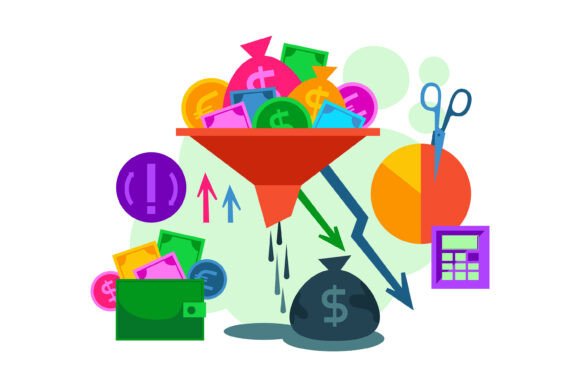
Consider the visual representation of this concept: a funnel teeming with cash flow symbols. At the top, we have gross revenue. As it narrows, we subtract the necessary costs—COGS (Cost of Goods Sold), essential labor, and marketing. The goal is to widen the narrow end of the funnel. We do this by treating every dollar spent as a design asset. Every expense should serve a specific function in your brand identity. If an expense doesn't contribute to your brand's recognition or your product's quality, it is visual noise that needs to be edited out.
Strategic Planning: The Calculator and The Scissors
A successful strategy for cost-cutting for business growth requires two distinct tools: the calculator and the scissors. The calculator represents the data-driven side of your business—analyzing margins, forecasting trends, and understanding your burn rate. The scissors represent the action—the decisive cuts needed to improve efficiency.
For small business owners and entrepreneurs, this balance is critical. You might be tempted to cut marketing spend first, but that can stifle growth. Instead, look at operational efficiency. Can you renegotiate your office lease or switch to a hybrid model? Can you automate invoice processing? These are the "scissor cuts" that trim the fat without touching the muscle.
Furthermore, this philosophy applies directly to your creative output. When developing logo design or packaging design, you don't need the most expensive materials to create a high-perceived value. You need smart design choices. A premium font or a well-crafted typeface can elevate a simple package, making it look expensive without the high production costs of embossing or foil stamping. This is where financial strategy meets design strategy.
Applying the Principle to Brand Assets
The journey of managing costs extends to the assets you purchase for your business. Whether you are a blogger, a publisher, or a content creator, you likely invest in design assets like stock photos, templates, and fonts. Smart cost-cutting here means looking for value and versatility.
Instead of buying a one-off script font for a single campaign, invest in a versatile font family that includes multiple weights and styles. This allows you to create variety in your web design and social media graphics without purchasing new assets every time. It’s about building a sustainable toolkit. A high-quality sans serif font paired with a legible serif font can cover 90% of your design needs, from editorial design to email newsletters.
Practical Guidance for Sustainable Savings
To truly master cost-cutting for business growth, you need a practical framework. It is not enough to make one-time cuts; you must build a culture of fiscal awareness. Here is how you can approach this evaluation:
- Audit Your Subscriptions: Just as you would review font pairing options to ensure they work well together, review your monthly SaaS subscriptions. Cancel anything that doesn't directly contribute to revenue or essential operations.
- Evaluate Vendor Fit: Are your suppliers the right size for your current volume? Sometimes, switching to a smaller, more agile vendor can save money and improve service.
- Optimize for Efficiency: In design, we optimize images for faster load times. In business, optimize your processes. Time is money. If your team spends hours on manual data entry, the cost of automation software is likely lower than the labor cost.
- Review Commercial Licensing: When buying assets like fonts or stock imagery for commercial projects, ensure you aren't overpaying for licenses you don't need. Conversely, ensure you are compliant to avoid legal fees later.
Ultimately, the graphic representing this journey is one of balance and direction. It shows that while the influx of capital is vital, the outflux must be managed with precision. By adopting a mindset of strategic reduction, you aren't just saving money—you are investing in the longevity and scalability of your brand. The scissors, when used wisely, don't just cut costs; they carve a path for growth.
The Visual Impact of Financial Health
There is a visual language to a healthy business. It looks organized, consistent, and professional. When you apply the principles of cost-cutting for business growth to your operations, you create a leaner entity that can move faster than bloated competitors. This agility allows you to invest more in high-quality design assets, better customer service, and innovative product development.
Think of your budget as a canvas. Every unnecessary expense is a smudge or a distraction. By cleaning up the canvas, you allow your core offerings—the "main subject" of your business—to stand out. Whether you are designing a new handwritten font for a boutique brand or managing a large-scale e-commerce store, the discipline of financial prudence ensures that your creative and commercial visions aren't held back by financial leaks. Keep the funnel clear, watch the flow, and direct the arrows toward growth.